
|
1941
|
Born September 20 in Tacoma, Washington, to George Chihuly and Viola Magnuson Chihuly. George Chihuly is a butcher by trade and a union organizer. Viola Chihuly is a homemaker and avid gardener. The family's ancestry is predominantly Hungarian, Czech, and Slavic on the Chihuly side and Swedish and Norwegian on the Magnuson side.
|
|
1957
|
Older brother and only sibling, George, is killed in a Navy Air Force training accident in Pensacola, Florida.
|
|
1958
|
His father suffers a fatal heart attack at age 51. His mother goes to work to support herself and Dale.
|
|
1959
|
Graduates from high school in Tacoma. Although he has no interest in pursuing a formal education, his mother persuades him to enroll in the College of Puget Sound (now the University of Puget Sound) in his hometown. Two accomplishments the following year—a term paper on Van Gogh and the remodeling of the recreation room in his mother's home—motivate him to transfer to the University of Washington in Seattle to study interior design and architecture.
|
|
1961
|
Joins Delta Kappa Epsilon fraternity and becomes rush chairman. Learns to melt and fuse glass.
|
|
1962
|
Disillusioned with his studies, he leaves school and travels to Florence to study art. Discouraged by not being able to speak Italian, he travels to the Middle East.
|
|
1963
|
Works on a kibbutz in the Negev Desert. Meets architect Robert Landsman in Jericho, Jordan, and they visit the site of ancient Petra together. Redirected after meeting Landsman and spending a year abroad, he returns to the University of Washington in the College of Arts and Sciences and studies under Hope Foote and Warren Hill. In a weaving class with Doris Brockway, he incorporates glass shards into woven tapestries.
|
|
1964
|
While still a student, receives the Seattle Weavers Guild Award for his innovative use of glass and fiber. Returns to Europe, visits Leningrad, and makes the first of many trips to Ireland.
|
|
1965
|
Receives B.A. in Interior Design from the University of Washington and works as a designer for John Graham Architects in Seattle. Introduced to textile designer Jack Lenor Larsen, who becomes a mentor and friend. Experimenting on his own in his basement studio, Chihuly blows his first glass bubble by melting stained glass and using a metal pipe. Awarded Highest Honors from the American Institute of Interior Designers (now ASID).
|
|
1966
|
Works as a commercial fisherman in Alaska to earn money for graduate school. Enters the University of Wisconsin at Madison, on a full scholarship, where he studies glassblowing under Harvey Littleton. It was the first glass program in the United States.
|
|
1967
|
Receives M.S. in Sculpture from the University of Wisconsin. Enrolls at the Rhode Island School of Design (RISD) in Providence, where he begins his exploration of environmental works using neon, argon, and blown glass. Visits the Montreal World Exposition '67 and is inspired by the architectural glass works of Stanislav Libensk_ and Jaroslava Brychtov‡ at the Czechoslovak pavilion. Awarded a Louis Comfort Tiffany Foundation Grant for work in glass. Italo Scanga, then on the faculty at Pennsylvania State University's Art Department, lectures at RISD, and the two begin a lifelong friendship. They consider themselves brothers.
|
|
1968
|
Receives M.F.A. in Ceramics from RISD. Awarded a Fulbright Fellowship, which enables him to travel and work in Europe. Invited by architect Ludovico de Santillana, son-in-law of Paolo Venini, Chihuly becomes the first American glassblower to work in the Venini factory on the island of Murano. Returns to the United States and spends the first of four consecutive summers teaching at Haystack Mountain School of Crafts in Deer Isle, Maine. There he meets Director Fran Merritt, who becomes a friend and lifetime mentor. Visits "The Block" (Block Island) for the first time, his favorite retreat in the United States.
|
|
1969
|
Travels again, this time with his mother, throughout Europe, visiting relatives in Sweden and making pilgrimages to meet glass masters Erwin Eisch in Germany and Jaroslava Brychtov‡ and Stanislav Libensk_ in Czechoslovakia. Returning to the United States, Chihuly establishes the glass program at RISD, where he teaches full time for the next eleven years. Students include Hank Adams, Howard Ben Tré, James Carpenter, Dan Dailey, Michael Glancy, Roni Horn, Flora Mace, Mark McDonnell, Benjamin Moore, Pike Powers, Michael Scheiner, Paul Seide, Therman Statom, Steve Weinberg, and Toots Zynsky.
|
|
1970
|
Chihuly and friends shut down RISD in protests over the Cambodian offensive. During the strike, Chihuly and student John Landon develop ideas for an alternative school in the Pacific Northwest, inspired by Haystack Mountain School of Crafts. Meets artist Buster Simpson, who later works with Chihuly and Landon at the school. Meets James Carpenter, a student in the Illustration Department, and they begin a four-year collaboration.
|
|
1971
|
On the site of a tree farm donated by Seattle art patrons Anne Gould Hauberg and John Hauberg, the Pilchuck Glass School is created. A $2,000 grant to Chihuly and Ruth Tamura from the Union of Independent Colleges of Art and additional funding from the Haubergs provide seed money for this innovative new school. From this modest beginning, Pilchuck Glass School becomes an institution that will have a profound impact on artists working in glass worldwide. Chihuly's first environmental installation at Pilchuck is created that summer. In the fall, at RISD, he creates "20,000 Pounds of Ice and Neon," "Glass Forest #1," and "Glass Forest #2" with James Carpenter, installations that prefigure later environmental works by Chihuly.
|
|
1972
|
While he is at Pilchuck, his studio on Hobart Street in Providence burns down. Returns to Venice with Carpenter to blow glass for the "Glas heute" exhibition at the Museum Bellerive, Zurich, Switzerland. He and Carpenter continue to collaborate on large-scale architectural projects, and, confining themselves to the use of static architectural structures, they create "Rondel Door" and "Cast Glass Door" at Pilchuck. Back in Providence, they create "Dry Ice, Bent Glass and Neon," a conceptual breakthrough.
|
|
1974
|
Returns to Europe, this time on a tour of European glass centers with Thomas Buechner of the Corning Museum of Glass and Paul Schulze, head of the Design Department at Steuben Glass. Makes his first significant purchase of art, "La Donna Perfecta," an art-deco glass mosaic. Upon returning to the United States, he builds a glass shop for the Institute of American Indian Arts in Santa Fe, New Mexico. Supported by a National Endowment for the Arts grant at Pilchuck, James Carpenter, a group of students, and he develop a technique for picking up glass thread drawings. In December at RISD, he completes his last collaborative project with Carpenter, "Corning Wall."
|
|
1975
|
At RISD, begins series of "Navajo Blanket Cylinders." Kate Elliott and, later, Flora Mace fabricate the complex thread drawings. He receives the first of two National Endowment for the Arts Individual Artist grants. Artist-in-residence with Seaver Leslie at Artpark, on the Niagara Gorge, in New York State. Begins "Irish Cylinders" and "Ulysses Cylinders" with Leslie and Mace.
|
|
1976
|
Travels with Seaver Leslie to Great Britain and Ireland. An automobile accident in England leaves him, after weeks in the hospital and 256 stitches in his face, without sight in his left eye and with permanent damage to his right ankle and foot. After recuperating at the home of painter Peter Blake, he returns to Providence to serve as head of the Department of Sculpture and the Program in Glass at RISD. He invites Robert Grosvenor, Fairfield Porter, Dennis Oppenheim, Alan Seret, and John Torreano to RISD as visiting artists. Henry Geldzahler, curator of contemporary art at the Metropolitan Museum of Art in New York, acquires three "Navajo Blanket Cylinders" for the museum's collection. This is a turning point in Chihuly's career, and a friendship between artist and curator commences.
|
|
1977
|
Inspired by Northwest Coast Indian baskets he sees at the Washington Historical Society in Tacoma, begins the "Basket" series at Pilchuck over the summer, with Benjamin Moore as his assistant gaffer. Continues his bicoastal teaching assignments, dividing his time between Rhode Island and the Pacific Northwest. Charles Cowles curates a three-person show of the work of Chihuly, Italo Scanga, and James Carpenter at the Seattle Art Museum.
|
|
1978
|
Meets William Morris, a student at Pilchuck Glass School, and the two begin a close, eight-year working relationship. A solo show curated by Michael W. Monroe at the Renwick Gallery, Smithsonian Institution, in Washington, D.C., is another milestone in Chihuly's career.
|
|
1979
|
Dislocates his shoulder in a bodysurfing accident and relinquishes the gaffer position for good. William Morris becomes his chief gaffer for the next several years. Chihuly begins to make drawings as a way to communicate his designs. Together with Morris, Benjamin Moore, and student assistants Michael Scheiner and Rich Royal, he blows glass in Baden, Austria.
|
|
1980
|
Resigns his teaching position at RISD. He returns there periodically during the 1980s as artist-in-residence. Begins "Seaform" series at Pilchuck in the summer and later, back in Providence, returns to architectural installations with the creation of windows for the Shaare Emeth Synagogue in St. Louis, Missouri. Purchases his first building, the Boathouse, in Pawtuxet Cove, Rhode Island, for his residence and studio.
|
|
1981
|
Begins "Macchia" series, using up to three hundred colors of glass. These wildly spotted, brightly colored forms are dubbed "the uglies" by his mother, but they are eventually christened "Macchia," Italian for "spotted," by his friend Italo Scanga.
|
|
1982
|
With William Morris, tours one thousand miles of Brittany by bicycle in the spring. First major catalog is published: "Chihuly Glass," designed by RISD colleague and friend Malcolm Grear.
|
|
1983
|
Sells the Boathouse in Rhode Island and returns to the Pacific Northwest after sixteen years on the East Coast. Works at Pilchuck in the fall and winter, further developing the "Macchia" series with William Morris as chief gaffer.
|
|
1984
|
Begins work on the "Soft Cylinder" series, with Flora Mace and Joey Kirkpatrick executing the glass drawings. He is honored as RISD President's Fellow at the Whitney Museum in New York and receives the Visual Artists Award from the American Council for the Arts, as well as the first of three state Governor's Arts Awards.
|
|
1985
|
Returns to Baden, Austria, this time to teach with William Morris, Flora Mace, and Joey Kirkpatrick. Travels to Malta and the Channel Islands. Purchases the Buffalo Shoe Company building on the east side of Lake Union in Seattle and begins restoring it for use as a primary studio and residence.
|
|
1986
|
Begins "Persian" series with Martin Blank, a former RISD student and assistant, as gaffer. With the opening of "Objets de Verre" at the Musée des Arts Décoratifs, Palais du Louvre, in Paris, he becomes one of only four American artists to have had a one-person exhibition at the Louvre. Receives honorary doctorates from both the University of Puget Sound, Tacoma, and RISD, Providence.
|
|
1987
|
Establishes his first hotshop in the Van de Kamp building near Lake Union. Begins working hot glass on a larger scale and creates several site-specific installations, including "Puget Sound Forms" for the Seattle Aquarium. Donates permanent retrospective collection to the Tacoma Art Museum in memory of his brother and father. Begins association with artist Parks Anderson, commencing with the "Rainbow Room Frieze," an installation at Rockefeller Center in New York City. Marries playwright Sylvia Peto.
|
|
1988
|
Inspired by a private collection of Italian Art Deco glass, primarily designed by Martinuzzi and Scarpa, Chihuly begins "Venetian"series. Working from Chihuly's drawings, Lino Tagliapietra serves as gaffer. Receives an honorary doctorate from the California College of Arts and Crafts, Oakland.
|
|
1989
|
With Italian glass masters Lino Tagliapietra and Pino Signoretto, and a team of glassblowers at Pilchuck Glass School, begins "Putti Venetian" series. Working with Tagliapietra, Chihuly creates "Ikebana" series, inspired by his travels to Japan and exposure to ikebana masters.
|
|
1990
|
Purchases the historic Pocock Building located on Lake Union, realizing his dream of being on the water in Seattle. Renovates the building and names it The Boathouse, for use as a studio, hotshop, archives, and residence. Travels to Japan.
|
|
1991
|
Begins "Niijima Float" series with Rich Royal as gaffer, creating some of the largest pieces of glass ever blown by hand. Completes a number of architectural installations, including those for GTE World Headquarters in Irving, Texas, and the Yasui Konpira-gu Shinto Shrine in Kyoto, Japan. He and Sylvia Peto divorce.
|
|
1992
|
Begins "Chandelier" series with a hanging sculpture for the exhibition "Dale Chihuly: Installations 1964–1992," curated by Patterson Sims at the Seattle Art Museum. Honored as the first National Living Treasure by the Institute for Human Potential, University of North Carolina, Wilmington. Designs sets for Seattle Opera production of Debussy's "Pelléas et Mélisande," which premieres in 1993. The "Pilchuck Stumps" are created during this project but are not widely exhibited.
|
|
1993
|
Begins "Piccolo Venetian" series with Lino Tagliapietra. Alumni Association of the University of Washington names him Alumnus Summa Laude Dignatus, its most prestigious honor. Creates "100,000 Pounds of Ice and Neon," a temporary installation in the Tacoma Dome, Tacoma, Washington, attended by 35,000 visitors in four days.
|
|
1994
|
"Chihuly at Union Station," five installations for Tacoma's Union Station Federal Courthouse, is sponsored by the Executive Council for a Greater Tacoma and organized by the Tacoma Art Museum. Hilltop Artists in Residence, a glassblowing program for at-risk youths in Tacoma, Washington, is created by friend Kathy Kaperick; Chihuly assists with instruction of youths and is a major contributor. Discussions begin on a project to build the Museum of Glass on the Thea Foss Waterway in Tacoma and to design the "Chihuly Bridge," which will connect the museum to Tacoma's university district.
|
|
1995
|
"Cerulean Blue Macchia with Chartreuse Lip Wrap" is added to the White House Collection of American Crafts. "Chihuly Over Venice" begins with a glassblowing session in NuutajŠrvi, Finland, and a subsequent blow at the Waterford Crystal factory, Ireland. Creates "Chihuly e Spoleto," an installation for the 38th Spoleto Festival of the Two Worlds, in Spoleto, Italy. Receives an honorary doctorate from Pratt Institute, New York.
|
|
1996
|
"Chihuly Over Venice" continues with a blow in Monterrey, Mexico, and culminates with the installation of fourteen "Chandeliers" at various sites in Venice. The exhibition "Chihuly Over Venice" begins its national tour at the Kemper Museum of Contemporary Art in Kansas City, Missouri. Chihuly purchases the Ballard Building in Seattle for use as mock-up and studio space. Creates a major installation for the Academy of Motion Picture Arts and Sciences Governor's Ball following the Academy Awards ceremony in Hollywood, California. Creates his first permanent outdoor installation, "Icicle Creek Chandelier," for the Sleeping Lady Conference Retreat in Leavenworth, Washington. Receives an honorary doctorate from Gonzaga University, Spokane, Washington.
|
|
1997
|
Continues and expands series of experimental plastics he calls "polyvitro" in his newly renovated Ballard studio. "Chihuly" is designed by Massimo Vignelli and copublished by Harry N. Abrams, Inc., New York, and Portland Press, Seattle. A permanent installation of Chihuly's work opens at the Hakone Glass Forest, Ukai Museum, in Hakone, Japan. Chihuly and his team invite local high school students to photograph a blow and installation at the Vianne factory in France. Viola Chihuly is 90.
|
|
1998
|
Participates in the Sydney Arts Festival in Australia. A son, Jackson Viola Chihuly, is born February 12 to Dale Chihuly and Leslie Jackson. Hilltop Artists in Residence program expands to Taos, New Mexico, to work with Taos Pueblo Native Americans. Two large "Chandeliers" are created for Benaroya Hall, home of the Seattle Symphony. Chihuly's largest sculpture to date, the "Fiori di Como," is installed in the Bellagio Resort lobby in Las Vegas. Creates a major installation for Atlantis on Paradise Island, Bahamas. PBS stations air "Chihuly Over Venice," the nation's first high-definition television (HDTV) broadcast.
|
|
1999
|
Begins "Jerusalem Cylinder" series with gaffer James Mongrain, in concert with Flora Mace and Joey Kirkpatrick. In celebration of the millennium, Chihuly mounts his most ambitious exhibition to date: "Chihuly in the Light of Jerusalem 2000," for which he creates seventeen installations within the stone walls of an ancient military fortress, currently known as the Tower of David Museum of the History of Jerusalem. Travels to the Victoria and Albert Museum, London, to unveil an eighteen-foot "Chandelier" gracing the main entrance of the museum. Returns to Jerusalem to create a sixty-foot wall from twenty-four massive blocks of ice shipped from Alaska.
|
|
2000
|
Designs an installation for the White House Millennium Celebration. Creates "La Tour de Lumire" sculpture for the exhibition "Contemporary American Sculpture" in Monte Carlo. Marlborough Gallery represents Chihuly. More than a million people visit "Chihuly in the Light of Jerusalem 2000." Receives an honorary doctorate from Brandeis University, Waltham, Massachusetts. "Chihuly Projects" is published by Portland Press and distributed by Harry N. Abrams, Inc.
|
|
2001
|
"Chihuly at the V&A" opens at the Victoria and Albert Museum in London. Exhibits at Marlborough Gallery, New York and London. Creates a series of intertwining "Chandeliers" for the Gonda Building at the Mayo Clinic in Rochester, Minnesota. Receives an honorary doctorate from the University of Hartford, in Connecticut. "Chihuly in the Park, a Garden of Glass" exhibition opens at the Garfield Park Conservatory, Chicago. |
|
2002
|
Creates installations for the Olympic Arts Festival at the Salt Lake 2002 Olympic Winter Games. Viola Chihuly celebrates her 95th birthday. The "Chihuly Bridge of Glass,"conceived by Chihuly and designed in collaboration with Arthur Andersson of Andersson-Wise Architects, is dedicated in Tacoma, Washington.
|
| 2003 | Chihuly's exhibition, Mille Fiori, inaugurates the Tacoma Art Museum's new building. The Museum designs a vitrine to display their permanent collection of his works. |
| 2005 | Chihuly exhibition "Chihuly at Kew Gardens" in London, England opens in May and runs to January 6, 2006. |
| 2006 | Begins Black series with a Cylinder blow. Presents glasshouse exhibitions at the Missouri Botanical Garden and the New York Botanical Garden. Chihuly in Tacoma—hotshop sessions at the Museum of Glass—reunites Chihuly and glassblowers from important periods in his artistic development. The film Chihuly in the Hotshop documents this event. |
| 2007 | Exhibits at the Phipps Conservatory and Botanical Gardens, Pittsburgh. Creates stage sets for the Seattle Symphony's production of Béla Bartók's opera Bluebeard's Castle. |
| 2008 | Presents his most ambitious exhibition to date at the de Young Museum, San Francisco. Returns to his alma mater with an exhibition at the RISD Museum of Art. Exhibits at the Desert Botanical Garden in Phoenix. |
| 2009 | Begins Silvered series. Mounts a garden exhibition at the Franklin Park Conservatory, Columbus, Ohio. Participates in the 53rd Venice Biennale with a Mille Fiori installation. Creates largest commission with multiple installations on the island resort of Sentosa, Singapore. |

|
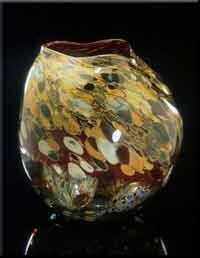 Leopard Spotted Basket Set 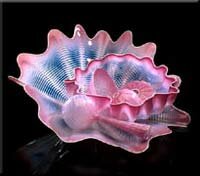 Spring Pink Persian Set 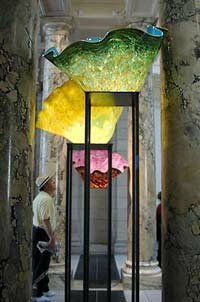 Macchia at the V&A 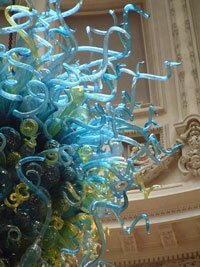 Chandelier at the V&A 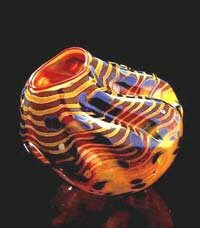 Cinnamon Macchia - Studio Edition  Paris Blue Basket Set - Studio Edition |
